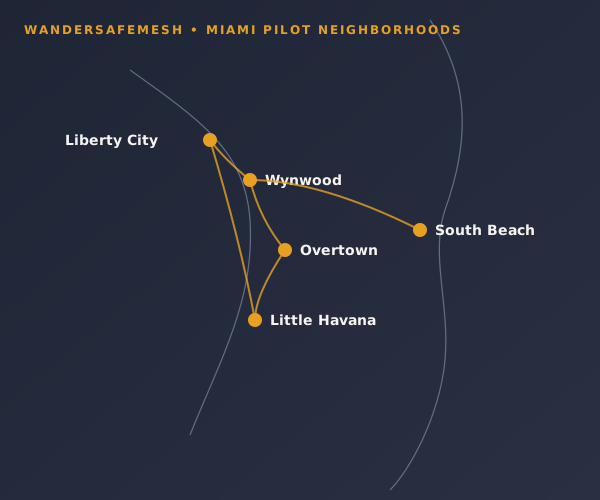
Who does WanderSafeMesh actually serve?
The communities existing emergency infrastructure fails: undocumented immigrants, unhoused people, LGBTQ+ residents with histories of institutional harm, low-income renters in flood-prone neighborhoods, and environmental-justice communities with disproportionate air quality and climate risk. The network exists to serve them — not data brokers, not governments, not researchers.
Why not just use cell phone alerts?
Existing tools have four gaps: they require internet and smartphones; they require trust in institutions (which many communities don't have for good reason); they don't monitor hyperlocal hazards (NWS data is regional, the corner you live on is not); and they don't feed data back to the community. WanderSafeMesh is designed to close all four. When the pilot is deployed: walk past a node, see the display, that's it.
Is the data sold?
No. Aggregate environmental data is published CC BY 4.0 — anyone, including researchers, can use it. Cost-recovery revenue from research subscriptions and event APIs funds maintenance. The hard rule: revenue is cost-recovery for infrastructure, never profit extraction from the community.
What happens if WanderSafe (the org) shuts down?
Open-source firmware (CC BY 4.0) and open-source STL files mean any makerspace can keep nodes running. Each city's QR code resolves to a community-partner-hosted page (SAVE Miami discussions in progress for Phase 1), not WanderSafe's server. The local community board can keep operating without us.
Can I build my own node and deploy it somewhere other than Miami?
That's the design intent. The hardware spec, firmware, and STL files are planned for CC BY 4.0 release after the pilot firmware lands, so any community group anywhere can fork the build, run their own neighborhood mesh, and (when the authentication layer ships) bridge into the wider WanderSafeMesh-compatible network. Even one node on a single block helps that block — coverage compounds with density, and there's no minimum threshold to start.
How do you keep rogue nodes from joining once it's open worldwide?
The planned trust model is layered: ESP32-S3 secure boot v2 + flash encryption (firmware integrity), cryptographic device attestation at mesh join (verifies the node before it relays), node whitelisting for critical-safety channels (panic-button traffic stays inside attested nodes), and community-reported revocation propagated mesh-wide (a compromised node gets quarantined fast). Local mesh participation stays open to anyone. Critical safety channels require attestation. Anyone can build; the network keeps its integrity.
Why Little Free Libraries?
LFL stewards are community trust anchors — already part of neighborhood fabric, maintained by volunteers who live there. LFL hosts get a physical education kit, a laminated card explaining the device, and direct contact with the community board. The node on an LFL works for everyone: no login, no phone, no English required.
How does the panic button route?
To a trained community responder — never police. In the Miami pilot, the planned routing is to ambassadors trained by partner LGBTQ+ orgs (SAVE Miami discussions in progress) who complete a 4-hour trauma-informed triage module before going live. Routing targets: Trevor Project or Trans Lifeline for mental health crises, immigration legal aid for ICE-related alerts, domestic violence hotlines for safety threats, and 911 only for life-threatening emergencies — and only at the responder's discretion. The architecture never auto-dispatches — every alert routes through a trained human. The no-police rule is enforced in firmware, not policy.